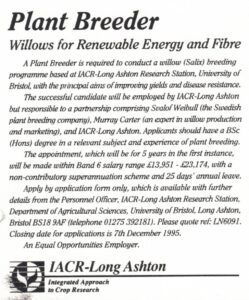
 30 years ago this week, I would have been completing my job application for the post of Willow Breeder at Long Ashton Research Station. I was fresh out of Aberystwyth University armed with a Masters degree in Plant Breeding. I had an interview just before Christmas, was offered the job on 8 January and started the post on 15 January 1996.
I remember how excited I was to be right at the epicentre of the fight against climate change – charged with breeding fast growing willows that would be used in bioenergy plants and to produce a rapid source of fibre products. In the months and years that followed my enthusiasm for willow breeding and the genus Salix knew no bounds. In moments of reverie I wondered if I would become only the second plant breeder in history to win the Nobel Prize! Like Norman Barlaug before me, I imagined I would be right at the helm of a second “Green Revolution”.
Nearly 30 years on I am one of the select few pioneers still active in this sector. But that’s what it is – a sector. Nowhere near an industry and so far, the potential to change the world for the better has not been harnessed. When I talk to a stranger, they are always fascinated about what I do, yet virtually none of them have ever seen a willow crop. All these years later there is still the same amount of willow in the ground as when I started the willow breeding job – around 1,500 hectares in the UK. I have to say that’s depressing.
So, what has happened? Well, the body of evidence continues to grow to the size of Everest. Scientists and protagonists continue to find multifunctional attributes and uses for this most versatile plant genus. The calls for Short Rotation Coppice (SRC) willow to be part of our net zero future continue to stack up to a veritable skyscraper. And yet the policy makers that need to turn this hard science into action seem to ignore the peer reviewed evidence and dismiss the advice of independent bodies (such as the Climate Change Committee) that were set up to provide the guidance. What a waste of everyone’s time. Millions have been spent on R&D, thousands and thousands of hours have been devoted on analysis, workshops and report writing but ultimately the decision makers are at best sitting on their hands and often worse still, keeping their heads firmly stuck in the sand pit.
Since, the long awaited and completely vacuous UK Biomass Strategy, myself and colleagues have spent around two years and about 10 meetings talking to representatives of DEFRA’s Forestry Innovation Team. (We made a fuss about the name at the start as we felt it was suggestive of a done deal with SRC willow firmly in also ran status, but were assured that the name didn’t imply that mind’s were already made up). However, at the most recent meeting we spent another hour of our time and found out the outcome of all our efforts and many hours of talking was that there is zero chance of any incentives for SRC any time soon. Well then, that’s a box ticked! They will say they have consulted stakeholders. I say they have ignored stakeholders and the hard evidence provided.
I’ve had enough. I’m done trying to work with policy makers. Being told that something will happen after the election, after the spending review, after the Land Use Framework etc etc. Sorry, but enough of the jam tomorrow. I’m also done with consultation responses. Boy oh boy, am I done with those! The information that I have put in front of policy makers probably has a Room 101 just for itself. I am fed up of running head first into a brick wall – Thanks for the memories guys!
Of course, as a born campaigner I still intend fighting the good fight and will probably keep running at brick walls, but I am going to try different angles of approach. I’ve tried my best to work the soft sell. It’s now time for tough talking to find a way to change the narrative. Imagine me as someone leaving the front bench and asking lots of difficult questions from the back benches.
I’m going to start telling it how it is. Some of this will be uncomfortable reading and listening for some organisations and individuals. As far as I am concerned
if you don’t know about something and you don’t do anything that is hardly defensible but if you do know about something and don’t do anything then that’s a dereliction of duty.
I’ll be pointing this out and making sure that people know who I think are responsible.
Over the next few weeks and months I’ll be speaking my mind on this subject.
The vast majority of my viewpoints will be backed up with hard evidence. There will be some personal opinions too. However, considering all the hard yards I have put in over three decades as a professional in this sphere, I believe my opinions have some merit.
I am determined to be part of substantive action to combat climate change during my working life. What we need is an approach that turns back the ticking clock of climate change. That means high yielding, productive plants that are cheap to grow, don’t take up much land and make a rapid difference. Unfortunately, the powers that be are keen to continue a failed and flawed approach using slow growing, expensive options that are inefficient uses of the land and are not favoured by farmers. Brilliant! So, climate change continues at pace, yet we continue to act as if there is no emergency.
I’m sorry to say that the status quo is not an option. That is no way to adapt to or mitigate against climate change. Yet that is the path that policy makers are resolutely sticking to which simply wastes more valuable time. I am incredibly angry that a key element of the arsenal is being ignored and passed over.
To paraphrase and invert a quote attributed to Voltaire –it’s high time that we started over and move on from a policy framework that makes
the average the enemy of the great,
The tardy the enemy of the rapid,
The inefficient the enemy of the effective.
Plenty more to come – I dearly hope you will stay tuned.